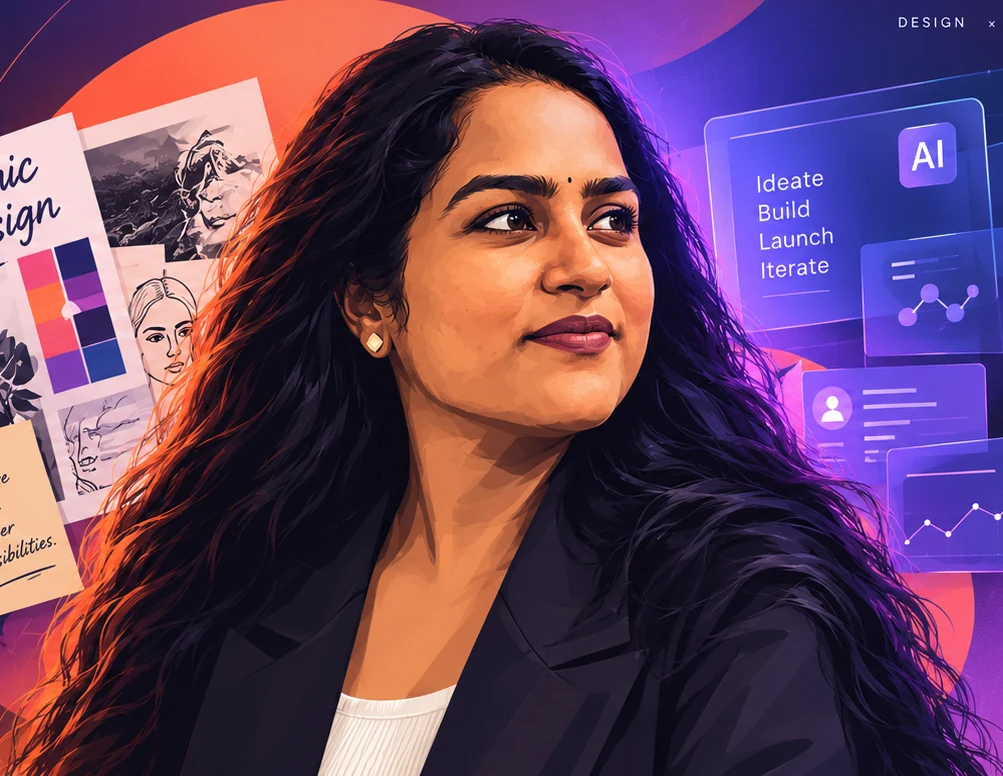
Syalima M Das, AI product manager and designer in Bengaluru

Designs it with the right brain.Tests it with the left.

Years of editorial and brand design taught me how a product should feel. An MBA in AI taught me to check whether people can trust it. I build AI products that get both right.

Illustrated portrait of Syalima M Das, with magazine layouts on one side and AI interface panels on the other Right brainDesign work Left brainAI work
Yes, left brain versus right brain is a myth. It's still a good metaphor.

Left brain

AI products I've built, tested and taken apart

Four projects with one question running through them: when can people trust what an AI tells them?

Product manager and builder, 2026

Sankhya+

A WhatsApp payment ledger for small traders that refuses to guess.

Small shops in India take orders and payment promises over WhatsApp but keep no ledger, so dues get forgotten and disputes come down to memory. Sankhya+ reads an exported chat and returns who owes what, with the original message attached to every entry.

  • Never invents an amount. An order with no agreed price is flagged, not filled in.
  • Every entry carries its source message, so a dispute has a receipt.
  • Runs offline from a single file on a mid-range phone.
  • Works in English, Hindi, Kannada and Malayalam, including romanised typing.

32 of 32 automated tests pass on the four trap cases: price haggling, unpriced orders, double-counted payments and future orders.
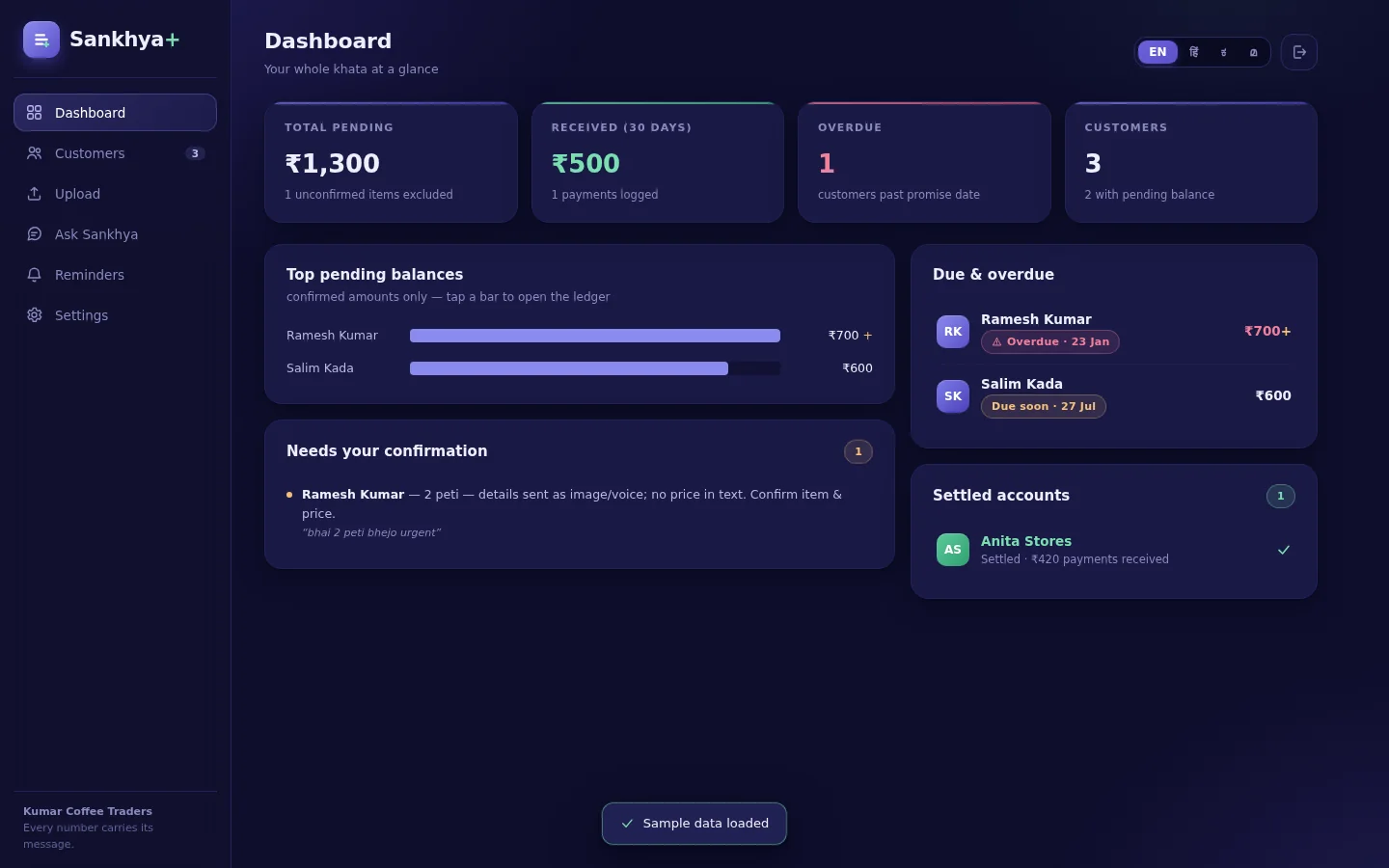
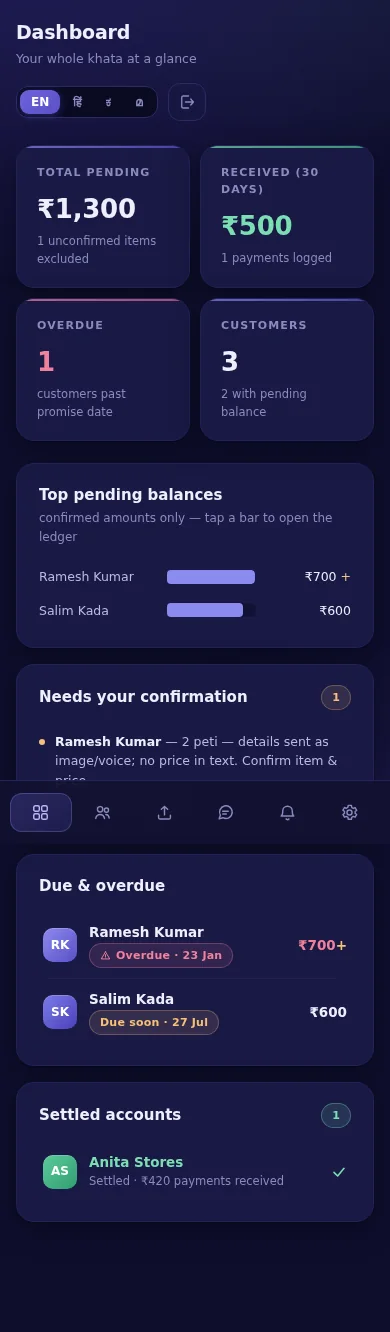
Sankhya+ dashboard showing total pending, payments received, overdue customers and items that need confirmation
Sankhya+ dashboard on a phone

Independent teardown, PRD and Figma prototype, 2026

Notion AI, when your pages disagree

Ask Notion AI a question whose answer is spread across pages that contradict each other, and it answers from one of them with no sign the others exist. I scoped one fix: show the sources first, and flag the conflict instead of quietly picking a winner.

Retrieve every page above a relevance threshold, extract the claim from each, then compare claims. I wrote a 20-question evaluation set, including stale-versus-current traps, and set a latency ceiling as the guardrail metric.

Not affiliated with Notion.

Evaluation framework, published July 2026

AI Search Benchmark 2026

Which AI search tool knows what it doesn't know? I wrote the scoring rubric before testing anything, then ran 20 questions across five categories through five tools, scoring eight weighted criteria.

Overall weighted score out of 5
Claude4.90
Grok 4.14.55
ChatGPT Search4.20
Gemini3.85
DeepSeek V4 Pro3.35

The main finding: obvious hallucination traps are mostly solved. The gaps now are freshness, reasoning depth and niche knowledge.

One evaluator, 20 questions, July 2026 versions. Directional, not definitive.

MBA research, JAIN University, 2026

Prompt to Publishing

Where generative AI helps magazine teams, and where it quietly adds work.

I surveyed 32 working designers and creative directors in Bengaluru on how they use generative AI in production, then turned the results into a three-phase product roadmap ranked by what practitioners asked for.

87.5%
use AI in their daily production work
62.5%
of projects still need 3 to 5 review cycles
84.4%
want one-click automated layouts
The correction paradox, mean agreement out of 5
AI makes projects faster4.6
AI output needs heavy human correction4.1

Time saved generating is partly spent correcting, so the roadmap targets layout, brand consistency and revisions rather than faster generation.

How I work on AI products

The same four habits run through every project, in this order.

  1. Start with people, not the tool

    Before designing anything, I study how the problem shows up in real life.

    In Sankhya+, I pulled orders and payments out of real chats by hand before any code existed.

  2. Decide what it must never do

    For AI products, the refusals matter as much as the features.

    Sankhya+ never invents an amount. The Notion AI fix never silently picks one source.

  3. Write the test before trusting the output

    A test set turns "it seems good" into something anyone can check.

    A 32-check answer key, a 20-question evaluation set, and a rubric written before the benchmark began.

  4. Verify, then ship

    AI can write the code. The job is catching where it's wrong.

    I built Sankhya+ with AI as the engineering tool, specified the rules, and checked every result against the answer key.

Right brain

Design work, a few favourites

Editorial design for Happiest Health's monthly magazine, plus illustration, identity and web work for clients. A small selection from many years of work.

Happiest Health magazine, 2023 to 2026. Stories with two spreads open on the first and continue to the second.

    How a designer got into AI

    I studied fashion communication at NIFT, then spent my career in design: leading a team of 12 designers at Syncsite, then directing the monthly magazine and digital platforms at Happiest Health.

    The turn came on an ordinary day. A week of my work was rejected, and a colleague produced an idea everyone liked with AI in under a minute. I didn't want to compete with that. I wanted to understand it.

    So I did an MBA in AI and built four products around one idea: when AI makes generating cheap, the valuable skill is judgment. Knowing what to build, what it must never do, and whether its output can be trusted.

    The designer is still here. She just writes test cases now.

    1. B.Des, Fashion CommunicationNational Institute of Fashion Technology, Kerala
    2. Senior Graphic DesignerSyncsite Technologies, Kochi. Led a team of 12 designers across global clients.
    3. Senior Creative DesignerHappiest Health, Bengaluru. Creative direction for 40+ issues of the monthly magazine.
    4. MBA, Artificial IntelligenceJAIN (Deemed-to-be University), Bengaluru. Four AI product projects.

    Both sides

    Let's build AI products people can trust.

    Move your cursor to develop the colour